<body>

Updates


A Better Perspective

The modern concern about the environment, and the very development of the science of ecology, began in the middle of the nineteenth century when human power over creation began to expand rapidly. As we might expect, good and evil were inextricably mixed in this development. On the one hand, industrialization and modern agriculture have enabled more people to live – and live a more fully human life – than ever before. After a difficult transition period, for instance, manual laborers in advanced economies achieved a security and sense of dignity never before seen in any society. Advances in technology have made famine – which was a regular scourge to humanity around the globe before modern times – a thing of the past, except in places where political tyranny or turmoil prevent intelligent development. Advances in medicine have all but eliminated diseases such as smallpox, tuberculosis, and malaria, and have made formerly life-threatening maladies such as measles, mumps, and others, relatively minor nuisances. All of this was achieved by the slow and patient accumulation of human knowledge and the creation of free institutions that enabled the fruits of that knowledge to be shared by even larger numbers of people.

On the other hand, industrialization also had its negative effects. Early industrialization polluted cities, disrupted agricultural communities, and challenged modern nations to find ways to integrate growing urban masses. However, these were largely transitional problems. Today, it is precisely industrialization, new forms of agriculture, and other human advances that are making it possible for humans to increasingly live well and in proper relation to the earth. Even in difficult cases, such as the increase in greenhouse gases, we want to be wary of taking too narrow a view of the matter that neglects a broader perspective on the goods of development. Fossil fuels, which come from beneath the earth, have made it possible for us to forego the far more destructive, inefficient, and polluting use of wood and other so-called natural fuels that must be harvested from the earth’s surface. Paradoxically, fossil fuels may have even helped save whales from extinction. Prior to learning how to use petroleum, humans had few alternatives to whale oil for generating heat and light.

Moreover, fossil fuels, such as coal and oil, have also had far-reaching positive environmental effects that a good steward should wish to consider in drawing up the global balance sheet. The first effect is to make it possible for farmers to replace beasts of burden with machines and, therefore, to cultivate land more efficiently. (Much of the developing world is now beginning to undergo this process of agricultural modernization today.) Second, fossil fuels have been turned into fertilizers that, together with new pesticides, other means of preventing spoilage, and advances in new plant species – the so-called Green Revolution – have produced so much more food per acre that large amounts of land have now been spared from cultivation altogether. For example, America’s forests, contrary to popular perception, have been growing steadily for the past fifty years and are actually larger than they were one hundred years ago. Even in the heavily populated coastal areas, small farms have returned to forestland. The result of all this is that despite its vast fossil-fuel consumption, North America currently shows a net minus in the amount of carbon dioxide it puts into the atmosphere. In other words, North America absorbs more carbon dioxide through plants and forests than it emits through industry. No one intentionally set out to produce these consequences, but human ingenuity, aimed at doing better with greater cost efficiency and lower amounts of raw materials, seems here to reflect a providential convergence of man and nature. Now that we are conscious of the effects of our activity on nature, we can set out to do even better.

If other countries in the world could imitate such ingenuity and efficiency, we would not see an exhaustion and despoliation of natural resources. Instead, we would see their enhancement and protection. Agricultural scientists have estimated that if the rest of the world could achieve the level of efficiency and care for the land exhibited by the average farmer in the developed world, then ten billion people – which is almost twice the current world population, and is a larger figure than is now expected when the population levels off in the middle of the century – could be fed on half the land. Put into concrete terms, this means that an area the size of India could simply be left untouched worldwide in spite of population growth. It is a modern scandal, then, that out of a misguided concern for the earth, some philanthropic foundations and environmental groups from developed countries, and some international agencies as well, have discouraged, or even refused to support so-called "unsustainable" agricultural practices. These practices are, in fact, necessary for saving and improving the lives of the world’s poor and hungry.

Excerpted from "The Catholic Church and Stewardship of Creation" recently published by The Acton Institute.

Labels: , ,


AG Investigating UPC Wind

Cuomo Probing Conduct Of Wind Power Companies

ALBANY—The Attorney General’s office has launched an investigation into two companies developing and operating wind farms across New York state amid allegations of improper dealings with public officials and anti-competitive practices.

Wind farms are clusters of large electricity-generating turbines powered by wind and connected to the electric grid.

Subpoenas were served on Newton, Massachusetts-based First Wind (formerly known as UPC Wind) and Essex, Connecticut-based Noble Environmental Power, LLC. They are part of an investigation into whether companies developing wind farms improperly sought or obtained land-use agreements with citizens and public officials; whether improper benefits were given to public officials to influence their actions, and whether they entered into anti-competitive agreements or practices.

In recent months, the Office of the Attorney General has received numerous complaints regarding the two companies from citizens, groups and public officials in eight counties alleging improper relations between the companies and local officials and other improper practices.

“The use of wind power, like all renewable energy sources, should be encouraged to help clean our air and end our reliance on fossil fuels,” said Attorney General Andrew Cuomo. “However, public integrity remains a top priority of my office and if dirty tricks are used to facilitate even clean-energy projects, my office will put a stop to it.”

The Attorney General’s subpoenas seek, among other things:

–All documents concerning any benefits conferred on any individual or entity in connection with wind farm activity.
–All agreements, easements or contracts with individuals regarding placement of wind turbines.
–Agreements between wind companies that may indicate anti-competitive practices.
–All documents pertaining to any payments or benefits received from local, state or federal agencies.

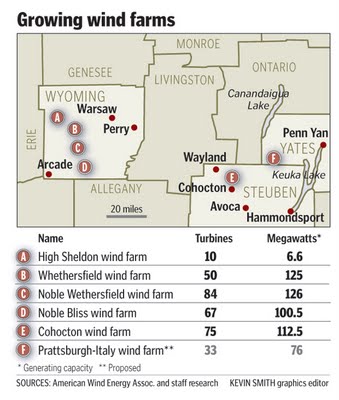
First Wind has three operational wind farms and 48 others in development across the country, according to its web site. First Wind developed the Steel Winds wind farm in Erie County and has wind farms in development in Steuben, Chautauqua, Genesee and Wyoming (GenWY Wind) counties.

Noble Environmental Power, LLC, has three active wind farms and five in development in Allegany, Chautauqua, Clinton, Franklin and Wyoming Counties.

The investigation is being led by Assistant Attorney General Andrew Heffner of the Syracuse Regional Office under the supervision of Special Deputy Attorney General Ellen Biben, who oversees the Attorney General’s Public Integrity Bureau. Assisting in the case are Investigators Thomas Wolf, David Bruce and Andrea Burnham.

Labels: ,


Ball Girl Makes the Play

Labels:


Prattsburgh Fiaso Unfolds


Prattsburgh tables eminent domain issue

7/18/08, Prattsburgh, N.Y. - A final vote by the Prattsburgh Town Board on whether to move ahead with eminent domain proceedings is on hold for a week.

The town board agreed Tuesday night to a proposal by town Councilman Steve Kula to try to iron out legal difficulties with two local school districts before voting on the eminent domain issue.

The board will invite representatives from the Prattsburgh and Naples central schools, the Steuben County Industrial Development Agency, and the county to discuss their issues in executive session at 7 p.m. June 24 at the town hall.

Earlier this year, the school districts challenged both an agreement between the town and wind farm developer UPC and a 20-year tax break for the developer provided by SCIDA. UPC has since changed its name to First Wind.

The two districts charge the town agreement was used to reduce payments they should receive through SCIDA’s tax incentive. The districts estimate they will lose a total of $1.6 million in funds they would have received under similar SCIDA agreements.

“I just want to be sure we’re playing from the same playing field,” Kula said later. “I want honesty and openness.”

Representatives of several of the agencies met recently with SCIDA board member and county Legislature Chairman Philip Roche, R-Erwin, but no settlement was reached. First Wind was not asked to attend the meeting.

The town board was poised to vote Tuesday night on condemning portions of roadway owned by seven property owners, a step necessary before eminent domain proceedings can begin. The seven have refused to sign easements allowing First Wind to lay underground electrical transmission cables for the proposed 36-turbine windfarm.

Tempers grew heated at the meeting as residents questioned town Attorney John Leyden about the proceedings.

Leyden said 60 out of 70 written concerns submitted during a recent public comment period had no bearing on whether the roadway should be condemned. Leyden said the comments dealt with the value of the wind farm and not condemnation.

The board will make a decision based on oral comments, 18 exhibits and the written comments, he said.

Ruth Matilsky, an opponent of the project, said Leyden’s explanations added to her confusion.

“I feel like I’m in the Twilight Zone,” she said.

The questions about the proceedings angered one man, who said the seven property owners should be forced to sign.

After words were exchanged between those for and against the issue, town Supervisor Harold McConnell told the opponents they had no right to tell supporters to shut up.

“You people make me sick,” he said, angrily.

by Mary Perham, Corning Leader

Labels: ,


Judge Nixes Iberdrola Deal


PSC should kill Iberdrola deal, law judge says

The state Public Service Commission should reject the proposed takeover of Energy East Corp. by a big Spanish utility, an administrative law judge said today in a much-awaited recommendation.

Energy East is the parent of both Rochester Gas and Electric and New York State Electric and Gas.

The Department of Public Service law judge, Rafael Epstein, picked apart the proposed $4.5 billion deal between Iberdrola SA and Energy East, writing that the commission should disapprove the transaction “on the ground that it does not satisfy the ‘public-interest’ requirement of Public Service Law.”

But if the commission does approve the sale of Energy East, there are pre-conditions that should be met, he wrote.

They include forcing Iberdrola to sell its wind power plants in New York; to agree to $646 million in public-benefit adjustments; and to abide by safeguards and rate proceedings as proposed by the PSC staff.

Iberdrola officials had earlier said they would walk away from the deal, which has been approved by other affected states and the federal government, if New York demanded they sell their wind power farms.

Epstein's recommendation sets the stage for the parties in the case to respond - they have until July 1 to do so -- and then a vote by the PSC.

Labels: ,


Most Get It


A new stewardship campaign paints evangelicals a lighter shade of green


Are evangelicals buying into global warming alarmism? Since February 2006, media reports throughout the country have claimed as much, often citing the Evangelical Climate Initiative (ECI), a document calling for federal caps on greenhouse-gas emissions and boasting the support of such influential Christian leaders as Rick Warren and Bill Hybels.

But recent research from The Barna Group indicates that evangelicals are among the most reticent people to board the climate change bandwagon. Only 33 percent of evangelicals in America consider global warming a major problem, compared to 62 percent of non-Christian religious people and 69 percent of atheists and agnostics.

Now, voices from the two-thirds majority of evangelical global warming skeptics have launched an initiative aimed at matching the decibel level of ECI backers. The "We Get It" campaign purports to better represent evangelicals regarding environmental stewardship. Chief among its declarations is an economic analysis suggesting that proposed solutions to climate change would do more to harm the world's poor than the potential impacts of rising global temperatures.

Click here to read the entire article by Mark Bergin in this week's issue of WORLD Magazine.

Labels:


Renewables Need Backup

E.ON warns over backup for renewables

In an article this past week in UK's The Guardian Mark Milner briefly reports that one of the major problems "renewable energy" (read "wind-generated energy") has is its need for constant backup:


One of Britain's leading energy providers warned yesterday that Britain will need substantial fossil fuel generation to back up the renewable energy it needs to meet European Union targets. The UK has to meet a target of 15% of energy from renewables by 2020.*

E.ON said that it could take 50 gigawatts of renewable electricity generation to meet the EU target. But it would require up to 90% of this amount as backup from coal and gas plants to ensure supply when intermittent renewable supplies were not available. That would push Britain's installed power base from the existing 76 gigawatts to 120 gigawatts.

Paul Golby, E.ON UK's chief executive, declined to be drawn on how much the expansion would cost, beyond saying it would be "significant". Industry sources estimate the bill for additional generation could be well in excess of £50bn.

E.ON's calculations are part of what the company calls its energy manifesto - designed to draw attention to what Golby described as Britain's "trilemma" - balancing the priorities of carbon, costs and energy security.

"We are calling for a new balanced and honest debate about the UK's energy needs, one that truly assesses the consequences in terms of carbon, cost and security of our energy choices."

E.ON is investing or has plans to invest in a series of new generation projects including wind, marine, gas and coal and has indicated interest in new nuclear stations. Golby said he wanted to to confront single-issue campaigners.

*It's interesting to compare the more modest European goal of attaining 15% renewable energy by 2020 with New York State's overweaning goal of 25% by 2013. Both goals are stretches with negative downsides. However, NYS already has 16% renewable in the form of hydro and another 28% in non-carbon emitting nuclear power. Why do we need fickle, expensive wind power, other than to clutter the natural beauty of our lovely state and enrich the coffers of Iberdrola and its ilk at the expense of NY tax- and rate-payers?

Labels: ,


New Nina Pierpont Book

Details:

  • Available August 2008.
  • Approx. $10 + shipping. Discounted bulk orders.
  • The complete and authoritative report on Wind Turbine Syndrome to date.
  • Includes peer-review reports by American medical school faculty and other American scientists (including acousticians).
  • Intended for clinicians and people living in the shadow of wind turbines.
  • Based on the evidence presented, it calls for a minimum of 2 km setbacks of industrial turbines from people's homes.

Visit www.windturbinesyndrome.com for purchasing information.

Labels: ,